
Short answer
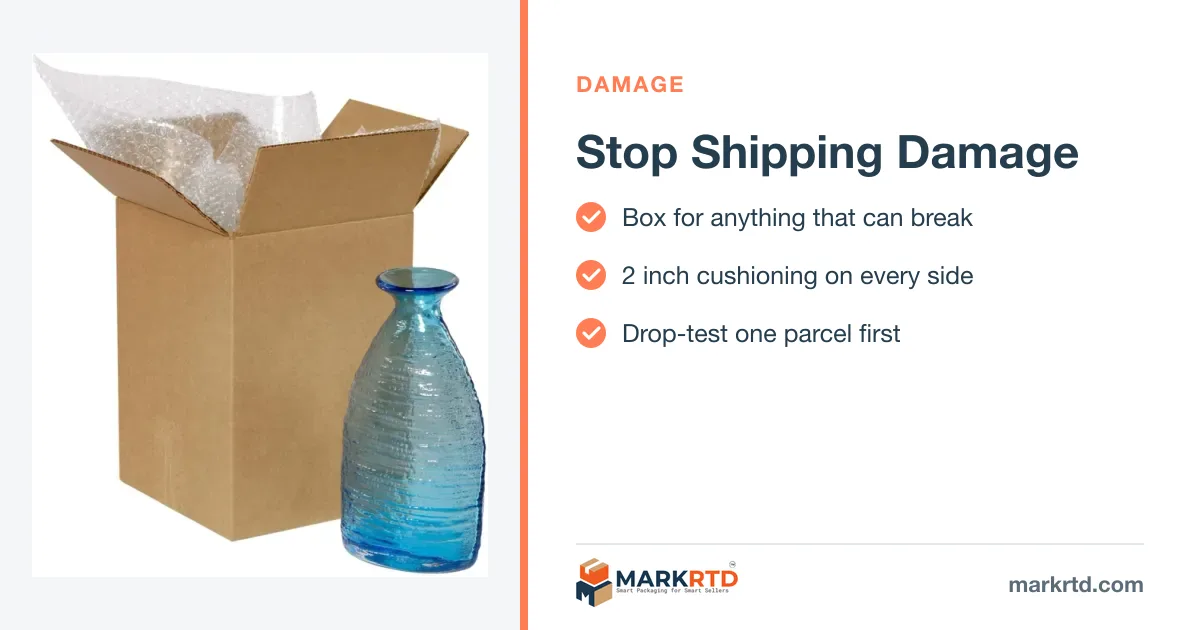
To reduce damage in shipping, put anything breakable or rigid in a corrugated box rather than a polybag, choose the box strength by weight (3 ply for light, 5 ply for most, 7 ply for heavy or fragile), wrap the product in bubble wrap, fill every gap so nothing moves, tape the box in an H pattern, and mark it fragile. Then drop-test one packed parcel from waist height before you ship hundreds.
Indian courier networks are fast, but they're not gentle. Parcels get stacked in vans, sorted on belts, thrown into bags and dropped at the doorstep. Your packaging has to survive all of that. A "damaged" return costs you the product, shipping both ways and often a bad review.
Here's how sellers who ship glass, cosmetics, electronics and home décor keep damage low.
1. Polybag or box?
A polybag protects from water, dust and opening. It doesn't protect from crushing or impact. Use a box for:
- Glass, ceramic, mirrors, photo frames
- Perfumes, cosmetics, liquids, oils
- Electronics and accessories with screens or circuits
- Shoes (ship the shoebox inside an outer carton or bag, never bare)
- Toys, books with hard covers, anything with sharp corners
Amazon Shipping India's guidelines say the same: wrap fragile items in cushioning, double-box heavy items, and use outer packaging even if the product has its own manufacturer box.
2. Pick the box strength by weight
| Box | Use for |
|---|---|
| 3 ply | Light items under about 1 kg that aren't fragile: books, small toys, boxed accessories |
| 5 ply | Most e-commerce products from about 1 to 5 kg, and fragile items that are light |
| 7 ply | Heavy items, glass and ceramics, multi-item orders, anything that gets stacked |
These are thumb rules. The paper quality matters as much as the ply count, so press the box sides with your thumb. A good box springs back.
3. Leave room for cushioning, not empty space
The box should be about 2 inches (5 cm) bigger than the product on every side. That space gets filled with cushioning, not air.
- Bubble wrap: wrap the product in two layers, bubbles facing in. Use heavier bubble wrap for glass and heavy items.
- Void fill: crumpled paper, extra bubble wrap or air pillows in the gaps, so nothing moves when you shake the box.
- Separate items: in multi-item orders, wrap each item on its own so they don't hit each other.
Shake test: close the box and shake it. If you hear or feel movement, add more fill.
4. Tape it properly
Use the H method: one strip along the centre seam, and one across each edge seam. Press the tape down firmly. For heavy boxes, use wider or two layers of tape on the bottom. Don't use plastic strapping; Amazon Shipping's guidelines say it damages packaging and sorting machinery.
5. Mark it fragile
"Fragile" or "Handle with care" tape and stickers don't guarantee gentle handling, but they help, and they show the customer and the marketplace that you packed with care. Put the fragile sticker on the top and sides, not over the label.
6. Don't make the parcel too big or too heavy
Oversized boxes get more shipping charge and more crushing. Amazon Shipping, for example, asks to keep items under 18 kg and within 70 × 70 × 45 cm. Check your box size against volumetric weight with the volumetric weight calculator before choosing a bigger box.
7. Drop-test before you scale
Before shipping a new product in volume, pack one exactly as you will ship it and drop it from about waist height onto each face, edge and corner. Open it. If anything is damaged, add cushioning or move up a ply. This 10-minute test saves dozens of returns.
8. Keep proof
Take a photo or video of the packed parcel and its weight before handover. If the parcel arrives crushed, that proof helps your claim with the marketplace or courier.
For other return reasons beyond damage, see ecommerce packaging to reduce returns.
Shop the packaging in this guide
Free seller tools for this
Frequently asked questions
How do I reduce product damage during shipping?
Use a corrugated box for anything rigid or breakable, wrap the product in bubble wrap, fill all gaps, tape in an H pattern, mark it fragile and drop-test one parcel before shipping in volume.
Which box is best for shipping fragile items: 3 ply, 5 ply or 7 ply?
Use 5 ply for most light fragile items and 7 ply for glass, ceramics and heavy items. 3 ply is only for light, non-fragile products.
How much space should I leave around a product in a box?
About 2 inches (5 cm) on every side, filled with cushioning so the product can’t move.
Does a fragile sticker reduce damage?
It helps handlers notice the parcel and shows you packed with care, but it is not a substitute for a proper box and cushioning.
Can I ship glass or cosmetics in a polybag?
It is risky. A polybag doesn’t protect against crushing or impact. Use a box with bubble wrap.
Read next
- Ecommerce Packaging to Reduce Returns: What Actually WorksPackaging fixes that cut damaged, missing and wrong-item returns for Indian online sellers: tamper-evident bags, right boxes, SKU labels and videos.
- Tamper Proof Packaging Benefits for Online SellersBenefits of tamper proof packaging for online sellers: fewer empty-packet claims, proof in disputes, less pilferage, safer RTOs, more trust.
- Amazon Packaging Requirements in India: Rules for SellersAmazon seller packaging rules in India for Easy Ship and Self Ship: polybag micron, boxes, size and weight limits, labels and own vs Amazon packaging.
- Polybag Size Guide for India: Measure, Thickness, POD or Non-PODHow to choose a courier polybag in India: measuring your product, micron thickness, POD vs non-POD, transparent vs opaque and when to switch to a box.