Short answer
Meesho asks suppliers to pack each order securely, stick the Meesho shipping label flat on the outside and hand it over by the dispatch date. Meesho recommends its branded packaging from authorised vendors, whose QR code is scanned against the label to cut courier and return fraud, though it is not compulsory on every shipment. Pack in the smallest secure bag or box, because Meesho’s shipping charge depends on weight.
Most Meesho suppliers learn the packaging rules the hard way: an RTO comes back with a different product inside, a "wrong product" claim gets rejected, or the shipping charge on a ₹249 kurti is higher than expected. None of these is about fancy packaging. They come from a few basic things done right every time.
Here is what Meesho expects, and what experienced suppliers do on top of it. Meesho updates its rules, so treat your Supplier Panel as the final word.
1. Use secure, sealed packaging for every order
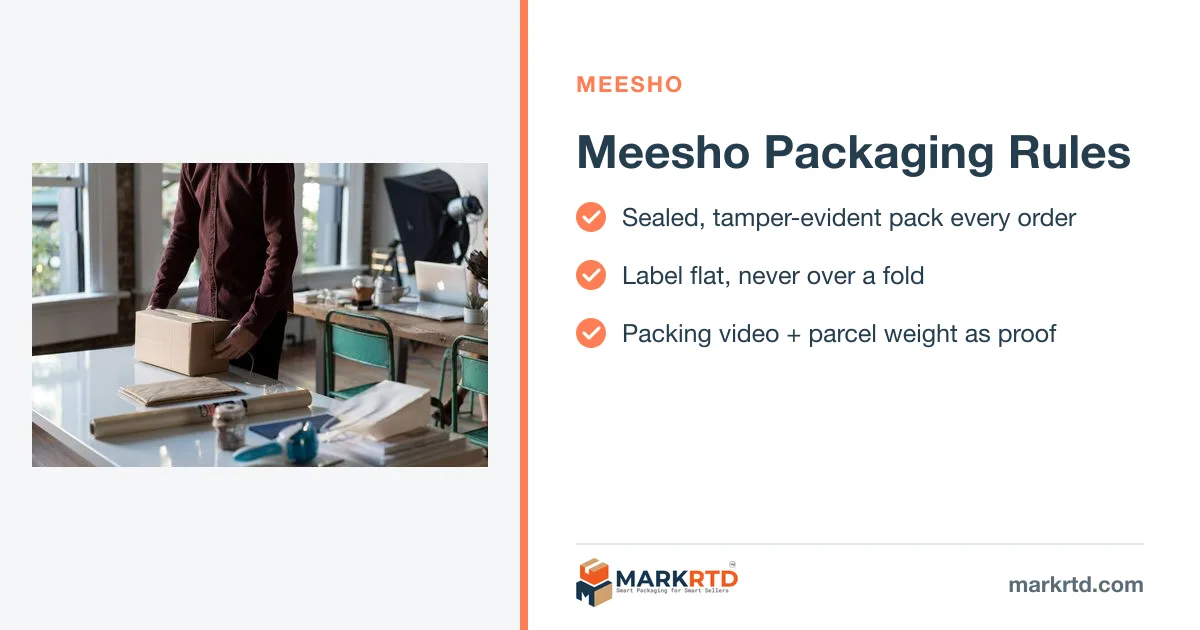
Every order needs an outer pack that closes fully and shows if it was opened. For clothing, sarees, home textiles and other soft goods, that is a tamper-evident courier polybag. For anything that can break or crush, it is a corrugated box with cushioning inside.
- Don't send the product in its retail pouch alone. Inner packs are not shipping packs.
- Don't reuse old marketplace bags or boxes with someone else's label on them. Couriers scan the wrong barcode and the parcel gets stuck.
- Seal the full flap. A half-sealed bag is one of the most common reasons for "open packet" complaints.
2. Meesho branded packaging: recommended, not compulsory
Meesho has its own branded packaging, sold by Meesho-authorised vendors. Each packet carries a QR or barcode. While packing, you scan the AWB on the shipping label and then the packet code, so Meesho knows exactly which packet carries which order.
The main reason is fraud. If an RTO or return comes back in a different packet, or the packet was opened, the mismatch is visible. According to Unicommerce's integration notes, Meesho recommends branded packaging for all shipments but it is not mandatory to record the packet ID on every one.
Our guide on Meesho authorised packaging material explains how to check that a vendor is genuine before you buy.
3. Print and stick the label correctly
- Print the label from the Supplier Panel only after the order is accepted, and use the label for that order only.
- Stick it on the flat front side of the bag or the top of the box, never over a fold, seam or edge.
- Make sure the barcode is sharp. A smudged A4 inkjet label is a common reason for pickup failures. A 4×6 thermal label is cleaner. See 4×6 thermal label printer.
- If you print on A4, crop the label so it fits the bag. The free Meesho label cropper turns the label PDF into 4×6 or 3×5 thermal labels with the SKU and quantity printed on each.
4. Pack to the right weight
Meesho's shipping charge depends on the weight of the parcel, and couriers can re-weigh and re-measure at the hub. If the parcel turns out heavier or bigger than what you declared, the charge goes up.
- Weigh the packed parcel, not just the product.
- Use the smallest bag that seals. A loose, oversized bag can measure into a higher volumetric slab.
- Check your numbers with the Meesho volumetric weight calculator before you set the product weight in your listing.
5. Keep proof of what you packed
Wrong product, missing item and empty packet claims are where suppliers lose the most money. The supplier who wins these disputes is the one with proof. Most experienced Meesho suppliers:
- Record a continuous packing video for each order, showing the product, the label with order number and the sealing of the bag, without cuts.
- Weigh the parcel on a digital scale in the same video, so the weight is visible.
- Keep the videos for at least as long as the return and claim window.
Meesho's claim process and the proof it accepts can change, so read the current claim rules in your Supplier Panel.
6. Hand over on time
Packaging rules don't end at the bag. Orders packed late count against your dispatch performance. Batch your packing: print all labels for the day, pack in SKU order, and make one manifest. The free Meesho manifest report tool puts the day's orders, couriers and SKUs on one sheet for handover.
A simple Meesho packing routine
- Print and crop labels for all ready-to-ship orders.
- Pick products by SKU with a picklist.
- Start the packing video. Show the label, the product and the bag.
- Pack, seal the full flap and scan the packet code if you use branded packaging.
- Stick the label flat and weigh the parcel on camera.
- Add to the day's manifest and hand over.
Shop the packaging in this guide
Free seller tools for this
Frequently asked questions
Is Meesho branded packaging compulsory?
Meesho recommends branded packaging for all shipments, but according to Unicommerce’s integration notes it is not mandatory to record the branded packet ID on every shipment. Check your Supplier Panel for the current rule.
Can I use plain courier bags for Meesho orders?
Plain tamper-evident courier bags are widely used by Meesho suppliers. Branded packaging adds a scannable packet code that helps against RTO and return fraud.
Does Meesho provide packaging material?
Meesho’s branded packaging is sold by Meesho-authorised vendors, not given free. You pay for your own packaging.
How do I avoid wrong product claims on Meesho?
Use tamper-evident packaging, record a continuous packing video with the label and weight visible, and keep it until the claim window closes.
Why is my Meesho shipping charge higher than expected?
Usually because the packed parcel is heavier or bigger than declared. Weigh the packed parcel and use the smallest bag that seals.
Read next
- Meesho Authorised Packaging Material: How It Works and Where to BuyWhat Meesho authorised (branded) packaging material is, how the QR packet code works with your shipping label, whether it is compulsory, and how to buy it safely.
- Meesho Polybag Size: Which Bag for Which ProductMeesho polybag sizes from 6.5×8 to 12.5×16 inch with what fits in each, how to pick the size for kurtis, sarees and jewellery, and how size affects Meesho shipping.
- Flipkart vs Meesho Packaging: Polybag Rules and DifferencesFlipkart vs Meesho packaging and polybag rules compared: branded bags, sizes, labels, what is compulsory and how to pack if you sell on both.
- Ecommerce Packaging to Reduce Returns: What Actually WorksPackaging fixes that cut damaged, missing and wrong-item returns for Indian online sellers: tamper-evident bags, right boxes, SKU labels and videos.