
Short answer
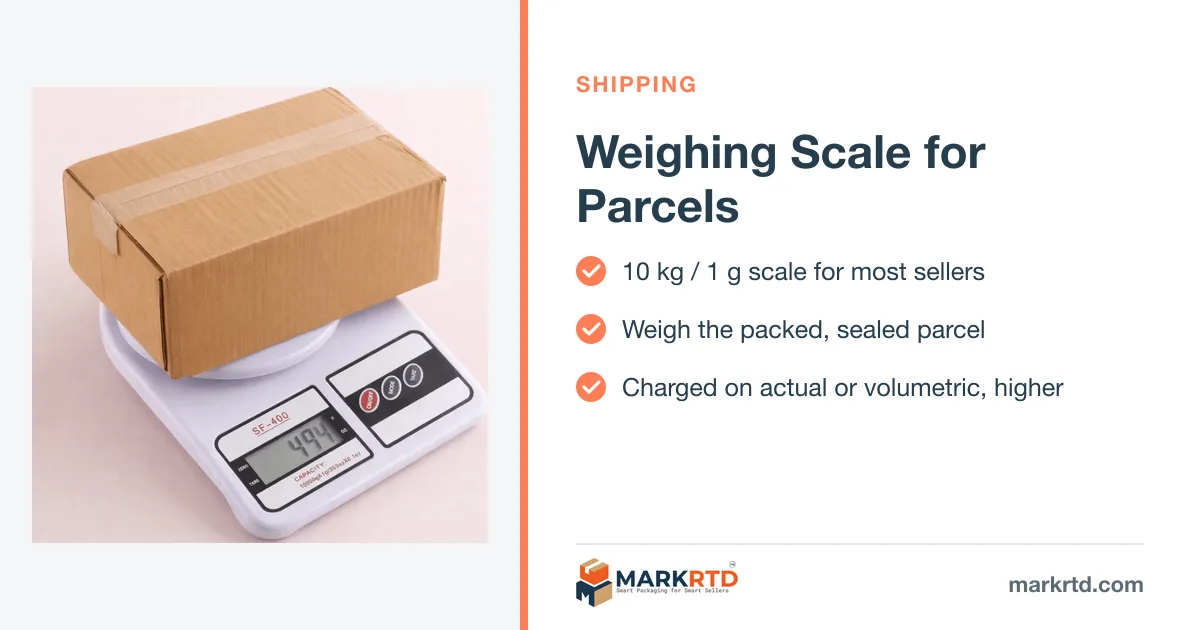
Most small online sellers need a digital scale with 10 kg capacity and 1 g accuracy, like the SF-400, for polybag and small box orders. If you ship heavier cartons, add a platform scale of 30–100 kg. Weigh every packed parcel, record it in the packing video, and enter that weight in your seller panel, because courier and marketplace shipping charges are based on the higher of actual and volumetric weight.
“Courier weight machine”, “parcel weight machine”, “SF-400”: sellers search for a scale once they get their first weight dispute or extra shipping charge. A ₹300–₹1,500 scale can save that every month.
Why weigh every parcel
- Shipping charges on Amazon, Flipkart, Meesho and couriers depend on weight slabs. A parcel just over 500 g can cost the next slab.
- Couriers re-weigh at the hub. If their weight is higher than yours, you pay the difference, sometimes with a penalty.
- A packing video with the scale reading is your proof to dispute a wrong weight.
- For “empty parcel” or “item missing” claims, the packed weight shows the product was inside.
Which scale to buy
| Scale | Capacity / accuracy | Good for |
|---|---|---|
| SF-400 style digital scale | Up to 10 kg, 1 g | Polybag orders, jewellery, cosmetics, small boxes |
| Compact platform scale | 30–50 kg, 2–5 g | Medium cartons, combo packs |
| Heavy platform scale | 100 kg+ | B2B cartons, bulk shipments |
For most clothing, jewellery and accessory sellers, a 10 kg / 1 g scale is enough. Pick one with a tare button, a flat top big enough for your largest polybag, and a clear display.
Actual weight vs volumetric weight
A scale gives you the actual weight. Couriers also calculate volumetric weight from the size: length × width × height ÷ a divisor (often 5,000 for cm). You're charged on whichever is higher. A light product in an oversized box can cost far more than its real weight.
Check both with the free courier weight calculator and volumetric weight calculator.
How to weigh parcels properly
- Put the scale on a flat, hard surface. Not on a cloth or a wobbly table.
- Switch on with nothing on it, or press tare.
- Weigh the packed, sealed, labelled parcel, not just the product.
- Keep the reading visible in your packing video.
- Enter the weight in the seller panel and round up, not down.
- Check the scale weekly with a known weight, like a sealed 1 kg pack.
Cutting weight to save on shipping
- Use the smallest bag or box that fits. See the courier bag sizes chart.
- Swap a box for a polybag where the product isn't fragile.
- Remove extra layers of packaging that add weight but no protection.
- Compare courier rates with the shipping rate calculator.
Shop the packaging in this guide
Free seller tools for this
Frequently asked questions
Which weighing machine is best for courier parcels?
For polybag and small box orders, a 10 kg capacity scale with 1 g accuracy, such as the SF-400. Add a 30–100 kg platform scale for heavy cartons.
What is the SF-400 weighing scale?
A compact digital scale with up to 10 kg capacity and 1 g accuracy, popular with small online sellers for weighing parcels.
Why do couriers charge more than my parcel weight?
They charge on the higher of actual weight and volumetric weight. A large, light parcel is charged on its size.
Should I weigh the product or the packed parcel?
The packed, sealed and labelled parcel, because that is what the courier weighs.
Read next
- Courier Bag Sizes Chart: Which Size for Which ProductCourier bag sizes from 6×8 to 20×23 inch in inches and cm, with what fits in each, how to read the size and how to pick the smallest bag that seals.
- What Is “Mark RTD” in Flipkart? Ready to Dispatch ExplainedMark RTD in Flipkart means marking an order Ready to Dispatch. When to do it, the steps before it, the dispatch-by deadline and how to avoid RTD breaches.
- How to Reduce Product Damage in Shipping: A Seller’s ChecklistHow to reduce product damage in shipping: choosing 3, 5 or 7 ply boxes, bubble wrap, void fill, taping, fragile marking and the drop test.
- 3 Ply vs 5 Ply vs 7 Ply Box: Thickness and Which One to Use3, 5 and 7 ply corrugated box thickness in mm, how much weight each holds, and which ply to use for ecommerce shipping of light, fragile and heavy products.