Short answer
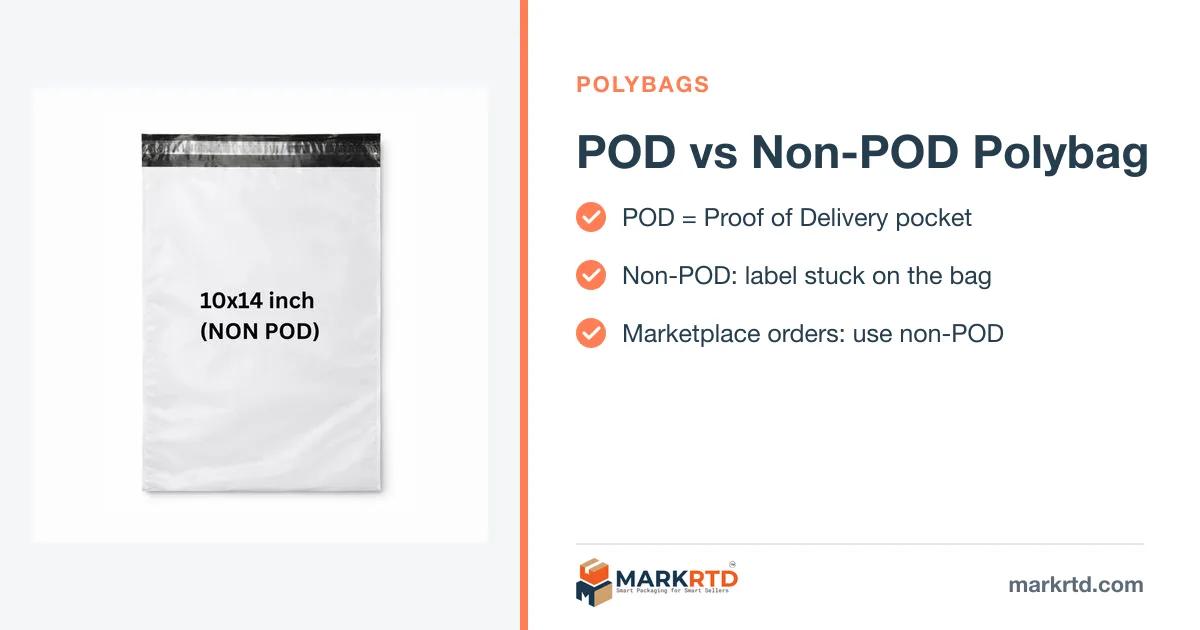
POD means Proof of Delivery. A POD polybag has a clear plastic pocket on the outside to hold an invoice, waybill or shipping slip. A non-POD polybag is the same tamper-evident courier bag without that pocket. Marketplace sellers on Amazon, Flipkart and Meesho mostly use non-POD bags, because the shipping label is stuck directly on the bag and the invoice goes inside.
If you've ever ordered courier bags, you've seen “POD” and “non-POD” in the listing and probably wondered which one you need. The difference is one small pocket, but it changes how you label the parcel.
What POD means on a polybag
POD stands for Proof of Delivery. A POD courier bag has a transparent sleeve, sometimes called a jacket, stuck on the outside. You slide a document into it: the invoice, the courier's waybill or a delivery slip. The courier can read it without opening the parcel.
A non-POD bag has no pocket. Everything else is the same: plastic film, self-adhesive tamper-evident flap, usually around 50–60 micron.
POD vs non-POD at a glance
| POD polybag | Non-POD polybag | |
|---|---|---|
| Outside pocket | Yes, clear sleeve | No |
| Label | Paper slip in the pocket, or label on the bag | Label stuck directly on the bag |
| Best for | Courier counter bookings, B2B shipments, documents that must travel outside | Amazon, Flipkart, Meesho, Myntra orders with printed labels |
| Cost | Slightly higher | Slightly lower |
| Risk | Slip can fall out or get swapped | Label is part of the bag, harder to swap |
Which one should online sellers use?
For marketplace orders, non-POD is usually right. You print a 4×6 shipping label from Seller Central, Seller Hub or the Meesho supplier panel and stick it flat on the bag. The invoice goes inside the parcel. There's nothing to put in a pocket, so the pocket just adds cost.
That's why marketplace-branded bags, like Meesho barcode polybags and Flipkart security polybags, are typically sold as non-POD.
POD bags still make sense when:
- You book shipments at a courier counter and they give you a paper waybill.
- You ship B2B orders where the buyer wants the invoice visible on the outside.
- You send documents or samples with a handwritten slip.
“POD” also means something else in e-commerce
Don't confuse the bag with proof of delivery as a courier record, the OTP, signature or photo the delivery person captures. And “POD” is also used for print on demand. On a polybag listing, POD always means the pocket.
Choosing the size and thickness
- Size: product width + thickness + 1 inch, and the same for length. The polybag size calculator does it for you.
- Thickness: 50–60 micron for clothing. Amazon wants more than 50 micron.
- Seal: a good tamper-evident flap tears the film if someone pulls it.
For the full size range, see the courier bag sizes chart and the polybag size guide.
Shop the packaging in this guide
Free seller tools for this
Frequently asked questions
What is a POD polybag?
A courier polybag with a clear Proof of Delivery pocket on the outside, used to hold an invoice, waybill or delivery slip.
What does non-POD polybag mean?
A courier polybag without the outside document pocket. The shipping label is stuck directly on the bag.
Which is better for Meesho, Flipkart and Amazon: POD or non-POD?
Non-POD, in most cases. Marketplace labels are stuck directly on the bag and the invoice goes inside, so the pocket is not needed.
What is the full form of POD in courier bags?
Proof of Delivery.
Are non-POD bags cheaper?
Usually slightly, because they don’t have the extra pocket.
Read next
- Courier Bag Sizes Chart: Which Size for Which ProductCourier bag sizes from 6×8 to 20×23 inch in inches and cm, with what fits in each, how to read the size and how to pick the smallest bag that seals.
- Polybag Size Guide for India: Measure, Thickness, POD or Non-PODHow to choose a courier polybag in India: measuring your product, micron thickness, POD vs non-POD, transparent vs opaque and when to switch to a box.
- Tamper Proof Courier Bag Sizes: Pick the Right OneTamper proof courier bag sizes from 6×7 to 20×23 inch, what fits in each, and how to tell a real tamper-evident seal from an ordinary sticky flap.
- Flipkart Packaging Material: What Sellers Need and How to Buy ItFlipkart packaging material explained for sellers: branded security polybags, sizes, tape, boxes and labels, how to order and how to avoid fake or wrong packaging.